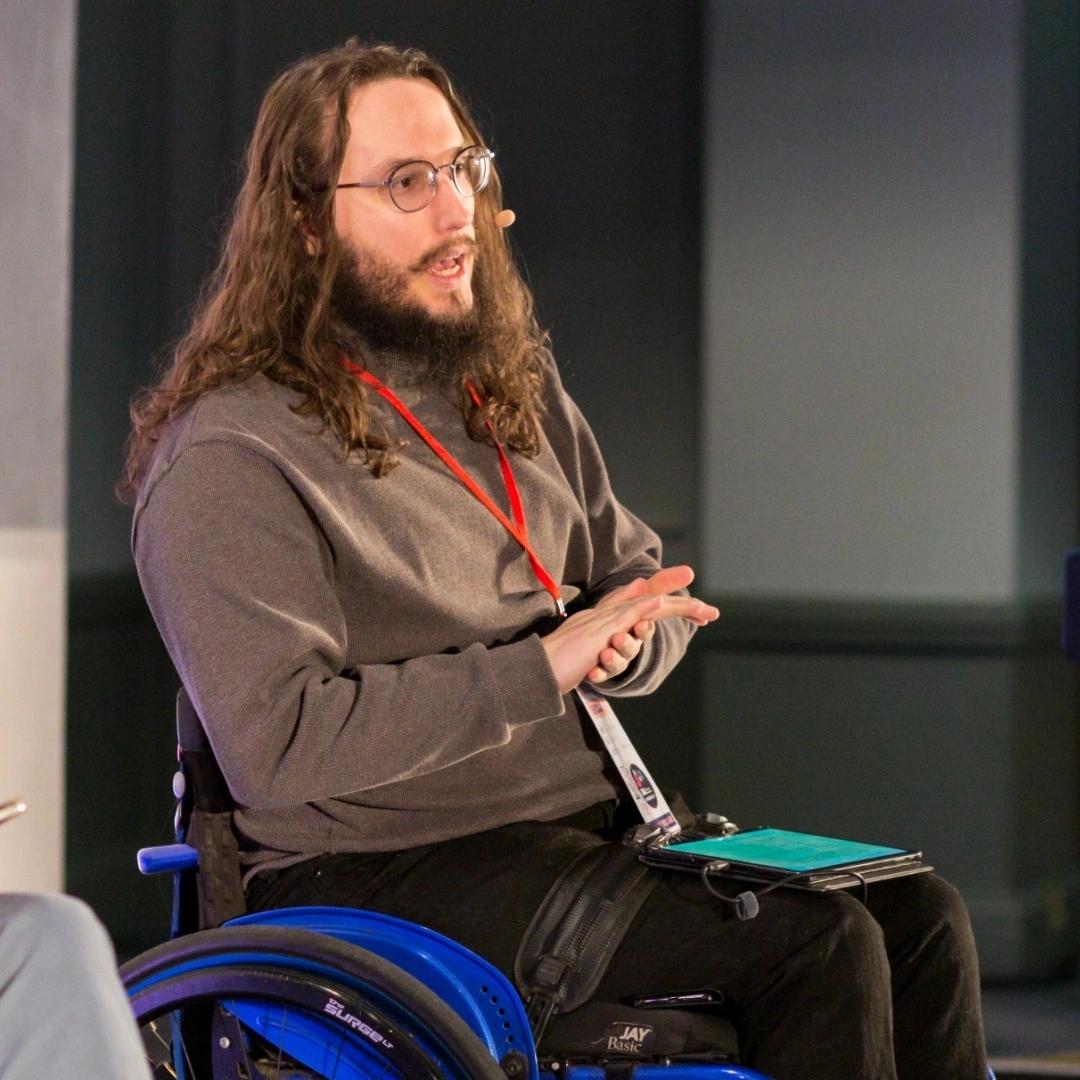
Ahead of Jisc Digifest 2026, this blog revisits a powerful conversation on centring disabled students’ lived experience in accessibility work. In this fireside chat with Piers Wilkinson, we explore why consultation isn’t enough, how co-creation improves course design, and why staff training and power-sharing are essential for meaningful inclusion in higher education.
Lessons lived
On Tuesday 10th March, Piers Wilkinson and I will be exploring some of the concepts we covered during last year’s fireside chat, Lessons Lived, in more depth. To add multiple perspectives, we’ll also joined by student and innovator Christopher Kaan Caudwell, and inclusive teaching and accessibility specialist, Lilian Joy.
Effectively centring disabled students’ voices is always a relevant conversation, and this year it’s all the more timely in the context of the Office for Students recent announcement of the development of a statement of expectations in relation to disability.
Here’s some highlights from last year’s conversation. I look forward to sharing more insights from the follow-up session.
The fireside chat
Kellie: How can we ensure that deaf, disabled and neurodivergent students are not just included in discussions about accessibility, but are actively shaping the solutions that we implement?
Piers: Lived experience, for those that haven’t encountered it before, is when someone with a protected identity, whether it’s disability, LGBTQ+, ethnic minority or a cultural background, experiences disadvantage and that is their lived experience in that area. So they know their unique experience.
Deaf, disabled and neurodiverse students are already included in conversations. But what does that actually mean in practicality? How do we get it across the line to be useful? Because I think what we miss is recognising that particularly in my role, I am a professional, I am a specialist, subject specialist and people recognise that expertise.
But what a lot of people forget is as a wheelchair user, as someone that’s autistic, a lot of the value that I bring to conversations is because I literally live it every day. How do we ensure that that expertise is also valued? And I think it comes down to, to talking about power to a certain extent in conversations.
I’ve talked before about the four C’s of co-production, co-creation, co-design and consultation. Almost everyone knows consultation. That’s what we do when we’re doing something to do with a group. We’ll consult with them. But realistically, that’s the bare minimum.
So I think to to understand lived experience, you have to go beyond just asking people, “Please share with us your feedback” and go beyond that to validate and say you know better than I your experience. So help us co-design this, help us co-create this, or at the very least help us co-produce it.
So the customer base, the students, the service users, whatever field you come from, you not only get that that usefulness, but we as disabled people are more likely to trust what you’ve given us. I talk about ‘disability dongles’ a lot, and that’s when someone’s gone, “Oh, that’ll be awesome. Like a robot wheelchair that can climb a flight of stairs. And a lot of wheelchair users are like, or… you could put in a lift.”
I know, you know, a lot more people will benefit from a lift than a piece of equipment that’s £40,000. Ironically, they cost an arm and a leg. So when we talk about lived experience, it’s about shaping solutions by doing the four C’s as much as you can from the get go. But centring the power with the people that it’s impacted by, you oversee budget, they oversee how it’s created and designed.
Kellie: Are there any examples you can share with us about where listening to the lived experience of disabled students has led to a positive change?
Piers: I’ve got a funny one and then I’ve got a real one. A funny one is don’t do a digital poverty questionnaire online, and don’t take six months to have someone explain why that’s a bad idea. So it is funny, but it is a real life thing that actually happens.
But a really good example I think, is how we design courses. Too often, it’s at the end of the course that a student will be asked, particularly disabled students, what was your assessment like?
I don’t know, I’ve not taken it yet. Or once you’ve done the assessment and you failed it, you don’t really know why you failed it. Or was it your revision? Was it was it your approach to the exam? Was it the exam itself that wasn’t adapted properly?
What’s worked really well in two universities that I’ve partnered with is having those conversations over summer when lecturers are redesigning it. But instead of having the lecturer redesign it by themselves, it’s having your disabled course reps involved: engaged individuals get paid to do an internship to help redesign that course.
And you’re hitting three things at once there. You’re getting co-creation, co-design, and co-production. You’re helping the lecturer make things accessible at the start rather than at the end. But importantly, you’re giving the power to the student as well as financial support, because you can’t just get a summer job as a disabled person half the time. You know, unless you turn me into a Roomba, I’m not exactly going to be working on the front of house in Tesco. So it’s multiple ways of approaching things.
Kellie: Let’s consider the extent to which people understand the responsibilities of all student-facing staff and their readiness to to meet those responsibilities. Do you want to tell us a bit about that?
Piers: So we’ll do a sort of a trick question here. And then I’ll go on to explain why it’s important. And make everyone anxious. [To audience] Indicate whether it’s a hand up or an elbow or whatever. If you feel 100% confident that every single staff member in your institution or organisation would know what to do if they suspected, or were made aware, that a student or other staff member had a disability. We’ve got one.
Out of everyone in the room, only one person is confident that in their organisation every staff member knows what to do. Now, if anyone’s heard of the Abrahart case, the judgement from the judge in the appeal stated that a staff member, suspecting or being made aware via the student or staff member disclosing or talking about it, counts as the entire institution being made aware in terms of legal sense.
Now, when do those managing risk make disability inclusion training mandatory? Because if you think about the risk, it makes staff training really important. So it’s not just about being confident about signposting because signposting isn’t enough. That’s also what the judge said. There’s a note of learning as well from the Equality and Human Rights Commission. There’s guidance on the NADP [National Association of Disability Practitioners] website about the case specifically.
But what I really wanted to start this conversation off with is pointing out that 99.7% of you aren’t confident in your fellow staff members in supporting and recognising a disabled person or disabled student, and yet, it’s critical.
Kellie: So how do we get there? What does good staff training look like?
Good training is the kind that moves people from “I think I know” to “I am confident in what this means for me, for my role, and for the student in front of me right now.”
It’s not about turning every staff member into a disability expert; it’s about giving people the confidence to recognise when something might be a barrier, to understand what their responsibilities are, and to know the next step they can take that won’t unintentionally cause harm.
That means training that’s practical, scenario‑driven and rooted in lived experience, preferably delivered by disabled people.
It also can’t be a one‑off. You can’t rely on a single two‑hour session to sustain a whole career’s worth of inclusive practice. It needs refreshers, CPD, community of practice spaces, disabled students’ voice, and ultimately institutional and personal accountability – knowing what to do when things go wrong, because we’re human and they will.
A shameless self-plug as a Director, but NADP offers great training and development for both disability practitioners and wider staff teams, matching professional expertise with lived realities.
Good training is building programmes that draw on lived experience to help staff shift from fear of “getting it wrong” to the confidence in doing it right.
Ultimately, the goal of good staff training is simple: when a disabled student trusts you with information about their access and barriers, every person they meet afterwards should be at least as safe, informed, and supportive as the first. Because inclusion shouldn’t depend on catching the “right” staff member on the “right” day. It should be embedded, predictable, and practised – every time, by everyone.
[Transcript provided by Verbit.]